Pages

Showing posts with label Science. Show all posts

Tuesday, November 2, 2021

Solar and Lunar eclipse

 Solar Eclipse:

How do they occur? Solar eclipse occur during the day when the sun disappears and its like night time during the day. This happens when the moon blocks the sun during the day. 

What do we see? Once the sun is completed we just see the shadow of the moon. 

When was the last one? 1965

When is the next one? 2028

Diagram


Lunar Eclipse: 

How do they occur? 

Lunar eclipse occurs at night, because the sun will reflect of the moon and its like the sun is out at night time. 

What do we see?

It looks like some of the moon is missing. 

When was the last one?

2019 - January 

When is the next one?

2022 - May

Diagram


Wednesday, March 24, 2021

Testing pH

 Aim: To test the pH of a range of household chemicals.

Method: Add a few drops of each chemical to a spot on your spotting tile. If a substance is solid or powdered you will need to mix it with a few drops of water before testing it. 

Results: 


Discussion:

The results tell me if it was an acid or a base. Some of the colors in turned to will tell me if it is an acid or a base or not. Red is a strong acid with a pH number of 0 and if its blue its a strong base with has a pH number of 14 and if its green that is neutral with a pH number of 7.

Conclusion:  

If I were to do this again I use different chemicals and sort it better.  

Monday, February 22, 2021

Model Atom

Aim: To make a model of a atom. 

Method: 

1. Choose an Atom to make (one between Hydrogen and Neon) 

2. Work out how many protons, neutrons and electrons it has.

3. Assign Protons and neutrons to a particular color bead.  

4. Get a ball of blue tac and stick the protons and neutrons to this to make your nucleus. 

5. Cut out the appropriate electron shells and draw on the electrons with vivid.

6. Connect the nucleus and electron shells with a piece of string. 

7. Create a label to go above the model so people know what you have created.  

Results:

Discussion: 

- Atomic number - 3 / Number of Protons and Electrons is the atomic number / Mass number - 7 / Number of Neutrons is the mass number. 

- Protons - 3 / Electrons - 3 / Neutrons - 4

- First shell can only have 2, Second shell can have 8 and third shell can also only have 8.

- Although Lithium is a metal it is soft enough to cut with a knife. 

- Along with Hydrogen and Helium, lithium was one of the three elements produced in large amounts of the Big Bang.

Conclusion: 

It worked really well and it lasted a while after it was created. If I were to make this again I would change the element to something a bit lighter so it would hold together. 

Wednesday, November 4, 2020

Heart Disection - 9hur2

  • What have we been learning about? / We have been learning about the heart and how it pumps our blood and how it helps us function.

  • Why are we dissecting heart? / To see what it's like on the inside and get a clear vision of something in real life instead of diagrams and drawings.

  • What are the parts of the heart? Did you see them? / Heart strings, Valves, Aorta, Ventricle, Arteries and we discovered the difference between the left and right side.

  • Did you enjoy the dissection? Why/why not? / Yes I enjoyed this and I think we should do it more often. I was super into the dissection because I'm really into science and the human/animals body.


 During the dissection we had to cut down the left side on the heart but our right so we could look into the heart. We saw the valves, heart strings and aorta. After that we cut around the whole heart to look into both sides. We then started exploring the heart and cutting into places that should not be cut. the equipment we used were Scissors, scalpel and tweezers. We did not see the Atrium or the veins because when the heart is being cut out of its body the atrium gets cut off and the veins are up top towards the lungs. 


Wednesday, July 1, 2020

Refraction and reflection

We are working on Refection and Reflection, we had some equipment in a light box we could use to bend the light. At 10 degrees it bent the angle to 8 degrees. At 20 degrees it bent the light to 15 degrees. at 30 degrees it was 20 degrees. at 40 degrees it was 20 degrees as well. 

Aim: To investigate how different types of lenses refract light.
Equipment: Triple-slit ray slide, power supply, a concave lens and a convex lens.
Method: 
1. Set up ray box, triple-slit ray slide and power supply.
2. Place the convex lens in the space on your paper. Place the ray box at the top of the page and shine the three rays of the light at the lens. Make sure the central light ray hits the lens at 90 degrees as indicated in the diagram. 
3. Carefully trace the direction of the incoming and refracted rays. 
4. Repeat using the concave lens. 

When the light through this type of lens, the rays all move away (diverge) from each other. One use of these lenses is in security peepholes in a door so that when the person on the inside of the room can see who is at the door without having to open it. 
That paragraph is call a Concave.

When light passes through this type of lens, they rays all move towards (converge) each other. One use of these lenses is in a camera, to focus the light onto the film or digital sensor. Magnifying glasses also use this type of lens. 
That paragraph is called Convex.

Tuesday, June 23, 2020

Dissection of an Eye

Today in science we were dissecting a cows eye. We had to cut of any extra flesh that was around the eye. Next we had to make an incision between the outside flesh and the cornea. We had to be careful that we didn't make a wrong cut or the humour inside the eye would squirt out. For more details you can watch this video on how to dissect a cows eye. https://www.youtube.com/watch?v=Fve8AQ5laYw&t=2s


  1. Aim 

To dissect a cows eye.
  1. Equipment

Tweezers
Incision scissors 
Gloves
News paper
  1. Method

A. Lay out your news paper and get gloves
B. Get your tools 
C. Cut any extra flesh around the eye
D. Make the incision and any other cuts
  1. Findings

The eye was really slimy but on the inside it looked cool
  1. Conclusion

The eye was really thick so it was hard to cut.

Monday, March 16, 2020

Chromatography

Aim:
To separate the different pigments from using chromatography.

Method:
1. Draw a line across the paper in pencil, 5cm from the bottom.
2. Draw a coloured dot in the middle of the line.
3. Measure out 10mL of water and place in the test tube.
4. Place the filter paper in the test tube and fold over the side. Make sure the pencil line is not in the water.
5. Wait for 5 minuets and observe the results.

Equipment:
1. Felt tip pen
2. Filter paper strips
3. Test tubes
4. Measuring cylinder
5. Pencil

Results:
I choose green and it stretched out and half of it was blue and the other half was yellow. So my one showed 3 pigments.

For the second one we had to do a black dot. It had 5 pigments. Blue, Purple, Black, Orange and a little bit of Pink.


As I was watching the colours change it was changing because the water was making it change. The darker the colour is the more pigments it will have. 


Evaporation

Aim: Is to use evaporation to
Hypothesis: The Copper sulfate will turn into crystals.

Equipment:

  • Copper sulfate
  • solution
  • 250mL Beaker
  • Heat proof mat
  • evaporating basin
  • element

Method: 
  1. Set up element
  2. Add 50mL of hot water to the beaker and place on the element.
  3. Add copper sulfate to the evaporating basin until it is quarter full.
  4. Carefully, place the the evaporating basin on top of the beaker. 
  5. Turn on the element to 8
  6. Heat the solution until most of the solvent has been evaporated and crystals of solute are forming. 
  7. Turn off the element- careful not to touch as will be hot for a long time.


Observations: The water looks like it is evaporating.

Thursday, August 8, 2019

The Water Cycle

AIM: TO LOOK AT THE WATER CYCLE AND HOW CLIMATE CHANGE IS AFFECTING IT.

Definition:


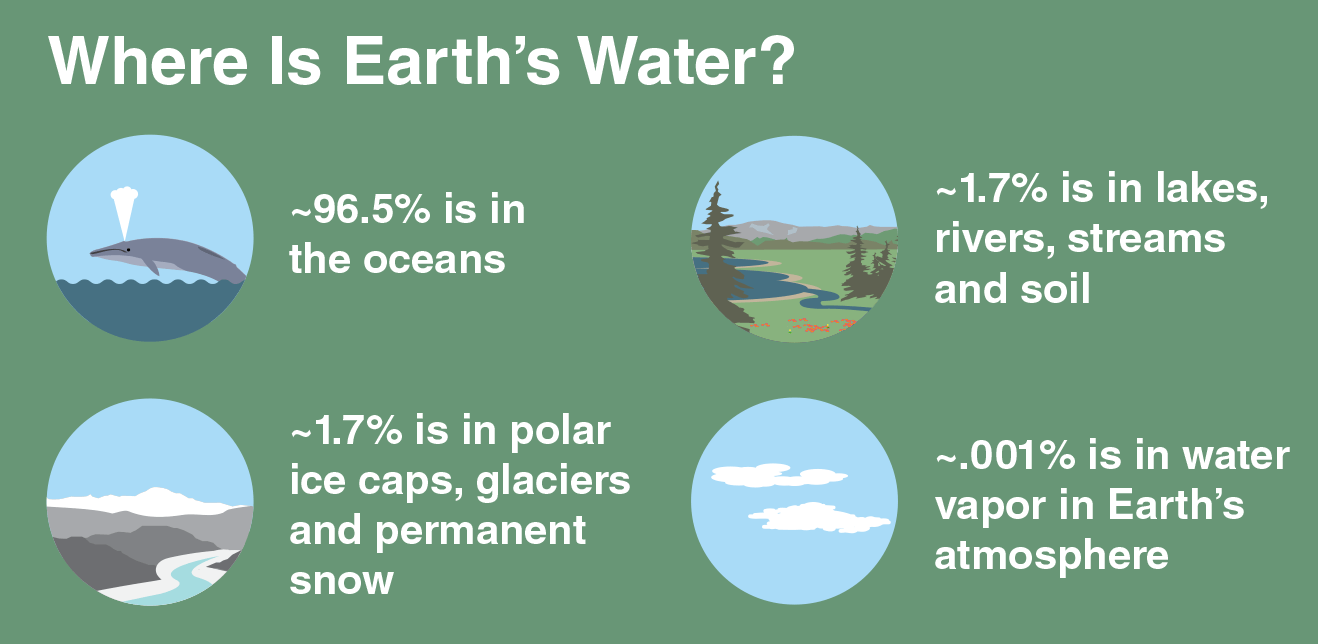
A green box with icons and white text. Text reads: Where is Earth's Water? 96.5 percent is in the oceans; 1.7 percent is in lakes, rivers, streams, and soil; 1.7 percent is in polar ice caps, glaciers, and permanent snow; 0.001 percent is in water vapor in Earth's atmosphere

Scientific words:


  • Evaporation. When water is heated by radiant energy it turns into water vapor.
  • Transpiration. Evaporation from plants.
  • Condensation. When water vapor cools, molecules join together and form clouds.
  • Precipitation. When clouds get heavy the waters falls as rain, sleet, hail, or snow.
  • Acidification: the action or process of making or becoming acidic.

We will be conducting an experiment that looks at the different ways that climate change is affecting the water cycle.
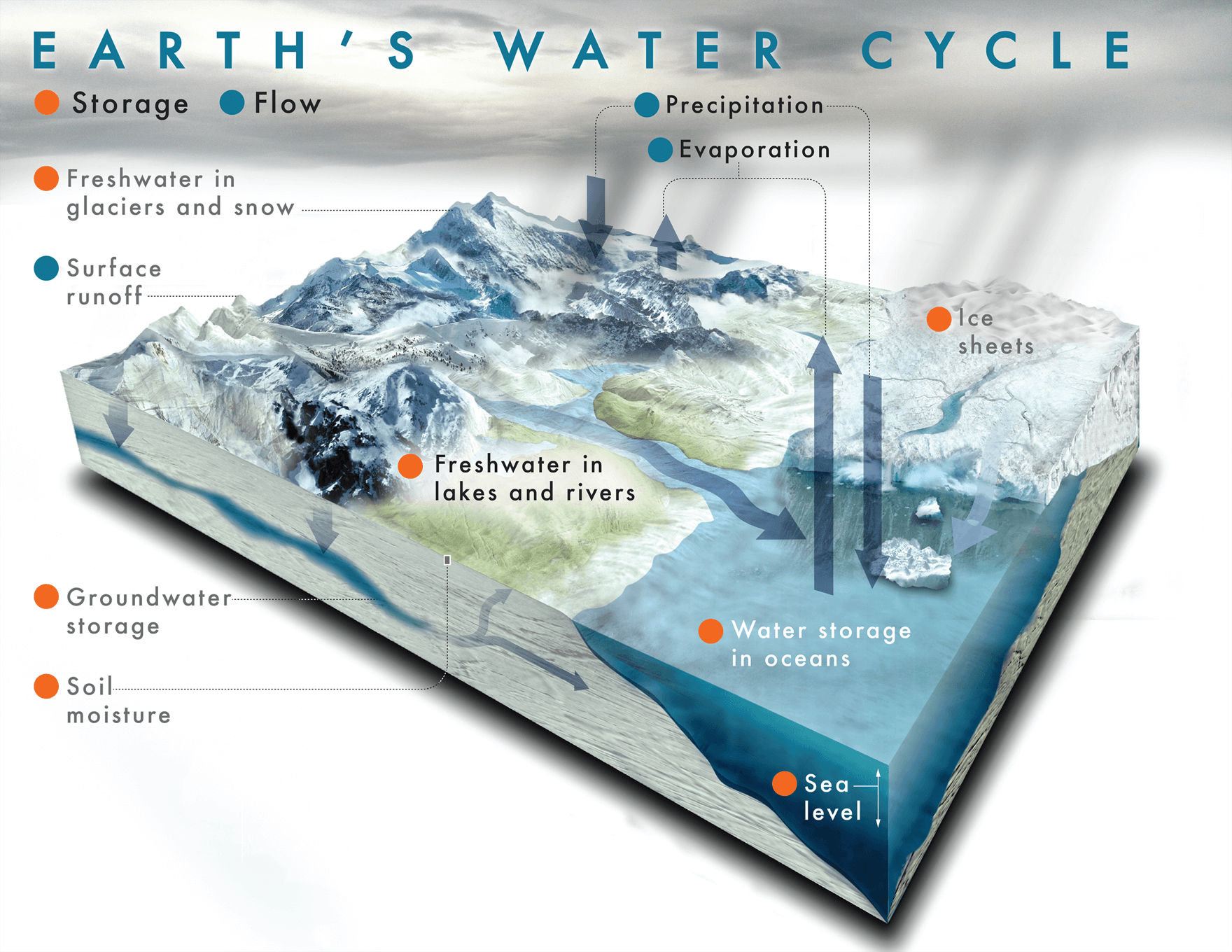
An illustration of the water cycle showing how water travels from rivers and streams to clouds to snow and back again

THE WATER CYCLE EXPERIMENT

Bag 1: Normal Water cycle
Bag 2: Water cycle with CO2 added: like Oceans in climate change
Bag 3: Water cycle with ice added: like Antarctica in climate change

Material:

  1. Bag
  2. Pen
  3. Water
  4. 2 drops of food colouring
  5. Litmus paper
  6. Soda

Steps:

  1.  Get into a group
  2.  Get your materials 
  3.  Draw the cycle on your bag
  4.  Put a cup of water/soda in a bag
  5. Put in 2 drops of food colouring in the bag.

Two Images:


Findings:


The Water Cycle: Bag 1
CO2 Water Cycle: Bag 2
Acid
Desert Water Cycle
Bag 3
Does it cycle?
Yes.Yes.Yes
Amount of Water
222
Acidity
121

Key: Water and acidity amount: 1 = none 
2 = small drips
3 = large drips

Other comments:

  1. Bag 1 has no acidity.
  2. Bag 1 has small drips of water.
  3. Bag 1 still cycles.
  4. Bag 2 has soda instead of water in it.
  5. Bag 2 has a small drip amount of acidity. 
  6. Bag 2 has small drips amount of water.
  7. Bag 3 has sand instead of water or soda.
  8. Bag 3 has no acidity.
  9. Bag 3 has small drips amount of water in it. 

Conclusion:

Bag 1, 2 and 3 all had small drips amount of water. Bag 1 and 3 and no acidity in its cycle. All of the bags water cycles were working. 


1. Ice cap melt
- Definition: A polar ice cap is a region in the North and or South pole and that is a planet covered in ice. While the Ice caps melt sea levels rise and the oceans become less containable.
- 2 Pictures:
 Image result for Ice cap melt

Image result for Ice cap melt

- How it affects climate change?
The changes in the amount of the sea's ice cap can disrupt regular circulation, there by leading to changes in the global climate. Even a small increase in temperature also can lead to warming over time. Which means the polar regions are the most sensitive to climate change on Earth.


2. Acidification
- Definition: Ocean acidification is the on going decrease in the pH of the Earths oceans. This is caused by taking up the carbon dioxide from the atmosphere. Sea water is a slight basic meaning of pH > 7, and the ocean acidification involves a shift towards pH neutral conditions rather than changing to acidic conditions.
- 2 Pictures
Image result for acidification

Image result for acidification
- How it affects climate change?
As us humans keep burning more fossil fuels the focus on the carbon dioxide in our atmosphere keeps continuing to rise. Which is making climate change make both air and sea temperatures get hotter and hotter. 

3. Deforestation
- Definition: 
- 2 Pictures:
Image result for deforestation

Image result for deforestation

- How it affects climate change?

4. Water Vapour
- Definition: 
- 2 Pictures:
- How it affects climate change?


Conclusion:

In this one we started with Precipitation. precipitation comes from evaporation. Precipitation is a big word for rain. Then we went out to Storms and Hurricanes. Sometimes rain can create storms and hurricanes that is why we put it there. Then we moved to Flooding because flooding can be caused by Hurricanes and Storms. Next is oceans because when there is a flood it can lead to the ocean. We did evaporation next because the sun will evaporate some of the flooding. We linked freshwater to evaporation because the heat can evaporate the salt from salty water then it will become fresh. After fresh water we did water vapour because water vapour is basically clean water. Back to Evaporation we linked off to another part and that's condensation because when something gets evaporated it leaves condensation behind. After condensation we did Carbon Dioxide because when you breathe out your breathing out Carbon Dioxide and it sometimes create moisture which it condensation. 


Draw a labelled diagram of the Water Cycle

Water cycle words:
  1. Precipitation: Precipitation is a big science word for rain. When water is evaporated it goes into the clouds and comes out as rain. 
  2. Hurricanes: Hurricanes are most likely to happen in the warmth of the water and it will just keep going till it dies out.
  3. Storms: Storms can be a big threat to our earth because it may get to dangerous and it can seriously hurt people. 
  4. Evaporation: Evaporation is when there is water and the sun will evaporate it. It will then go into the clouds and it comes out as rain. 
  5. Carbon Dioxide: When you breathe out your breathing out carbon dioxide. You breathe in Oxygen and it comes out Carbon Dioxide.
  6. Water: Water helps us survive. We get to drink it, swim in it and etc. 
  7. Oceans: Our Oceans are a home for heaps of our sea life. Our earth needs the oceans because without it our earth will be dried out. 
  8. Water vapour: Water vapour is a gas form. It can be formed from a boiling liquid and or ice. 
  9. Freshwater: Fresh water can include ice sheets, ice gaps, glaciers, ice bergs, bogs, ponds, lakes, rivers and streams.
  10. Flooding: Flooding can be a part of climate change. The ice is melting so it can create floods then the water levels will rise. 
SOLO Hexagons Activity

Water cycle words:

  1. Precipitation
  2. Hurricanes
  3. Storms
  4. Evaporation
  5. Carbon Dioxide
  6. Water
  7. Oceans
  8. Water vapour
  9. Freshwater
  10. Flooding